
How I Make $250,000/yr with my Gardening Boring Business
How Garden Rescuers makes $250K a year with newspaper ads, yard signs and gardening services.
Hello! Who are you and what have you built?
Hello! My name is Walt, and I run Garden Rescuers, a small local gardening business that typically generates around $250,000 in annual gross revenue.

We're not landscapers. We don't mow lawns, build patios or do hardscaping. We strictly focus on gardens, primarily perennial gardens, although we also work with vegetable gardens and annuals. It's a very specialized kind of business.
What we do is called fine gardening. A landscaper might go through a garden bed with a weed whacker, whereas we're pulling weeds out by the roots and cleaning everything up individually. It's much more detailed work, and it's physically exhausting.
I'm actually not a gardener myself. I've learned that most gardeners aren't necessarily great businesspeople, and most businesspeople aren't necessarily great gardeners. You need both sets of skills to make something like this work. My role is to manage the business and hire experienced people who know how to do the actual gardening.
In a typical year, we generate around a quarter of a million dollars in gross revenue. The business has experienced a particularly slow year recently, so that number certainly isn't guaranteed. We're a very small local operation, and the idea isn't to turn it into a massive landscaping company.
What's your business model, and how much money do you make?
We typically generate around $250,000 in annual revenue, and our current gardening rate is approximately $80 per hour. That's gross revenue, not my personal income or the company's profit.
One of the important parts of our business model is that all our gardeners work part time. Typically, they're working four or five hours a day, and we leave it to them to decide how many hours they want to work. We just make sure we have enough people available to handle whatever workload comes in.

This gives us flexibility. If business slows down, I'm not trying to figure out how to keep a full time crew busy when there isn't enough work. It also fits the nature of gardening because it's very physical work. Having someone work eight hours a day doing fine gardening can be exhausting.
We're also a seasonal business, operating for approximately six months out of the year. That affects everything from hiring to how we manage our workload.
Who is your ideal customer?
Most people assume our ideal customer is someone wealthy who has a huge property with lots of gardens. That's actually not the customer I look for.
The best customer is someone who's been gardening for years, sometimes decades, and absolutely loves their garden. They understand how much work goes into maintaining it, so they appreciate the work we're doing and are willing to pay for it.
A lot of our customers are retired. Others have experienced an injury or illness that prevents them from doing as much gardening as they used to. They've spent years taking care of their gardens, but eventually they reach a point where they just can't keep up anymore.

Suddenly, the weeds are everywhere, everything is overgrown, and the garden has gotten away from them. Now they need someone to come in and rescue it. That's why we're called Garden Rescuers.
Someone who's never done their own gardening might look at our estimate and think it's expensive. But someone who's spent 20 years maintaining their garden understands exactly what goes into the work. That's the kind of customer we want.
How did the business get its first customers, and what were the startup costs?
When the business first started, there wasn't a huge investment involved. There was a vehicle, some basic gardening hand tools and a newspaper advertisement that cost about $25 at the time.
That little advertisement started generating phone calls almost immediately.

There's a very important detail here, though. We had access to a local advertising publication that was particularly well suited to our customers. It's called the Yankee Flier, and it's been around for decades.
It's an unusual paper because the advertisements aren't neatly organized into categories. You have pages and pages of advertisements for completely different things, and people flip through them looking for what interests them. The funny thing is, people actually do that every single week.
That's what made it such an effective advertising channel for us. Our customers were already reading it.
I wouldn't tell somebody starting a gardening business today that they can spend $25 on an advertisement and expect their phone to start ringing. That's what the ad cost back then, and not every area has a publication like ours.
You need to find an advertising channel that's appropriate for your location and customer base. If you don't have something like that available, getting a business like this off the ground can be more challenging.
How do you price your gardening services?
We currently charge approximately $80 per hour, which is actually a little higher than what I consider the market rate.
We didn't start out that way. Like a lot of gardeners, we initially underpriced our services because we were afraid that if we charged too much, people wouldn't hire us. That's a natural tendency when you're trying to get customers, but I've learned that it isn't necessarily the smartest approach.
Our pricing process starts with an estimate. Before we do any work, we go through the customer's property and prepare a very detailed estimate, garden bed by garden bed.
We document everything that needs to be done. Are we going to clean up the beds? Remove weeds? Add mulch? We go through all of it so the customer knows exactly what they're agreeing to.
Once they approve the estimate, we ask for 50% upfront. After receiving that payment, we schedule the work and usually get the job completed within a week or two. The customer pays the remaining balance when we're finished.
Sometimes we get into a job and discover that something is going to take longer than expected. Maybe there's a section of the garden with roots or other problems we couldn't see when we prepared the estimate.
When we realize we're approaching the amount of time originally allowed, we stop and contact the customer. We explain what's happening, tell them how much additional time we expect it to take and ask whether they approve the extra work.
If they agree and sign off on it, we continue. We don't just keep working and surprise them with a much larger bill afterward.
What marketing channels bring in the most customers?
Believe it or not, approximately 60% to 70% of our business comes from that silly old newspaper.
I've tried just about everything else, but the newspaper continues to be our biggest source of customers. Our particular customer base reads it, and it reaches people who are interested in the services we provide.
The second best marketing method we have is yard signs, which bring in approximately 10% to 15% of our business.
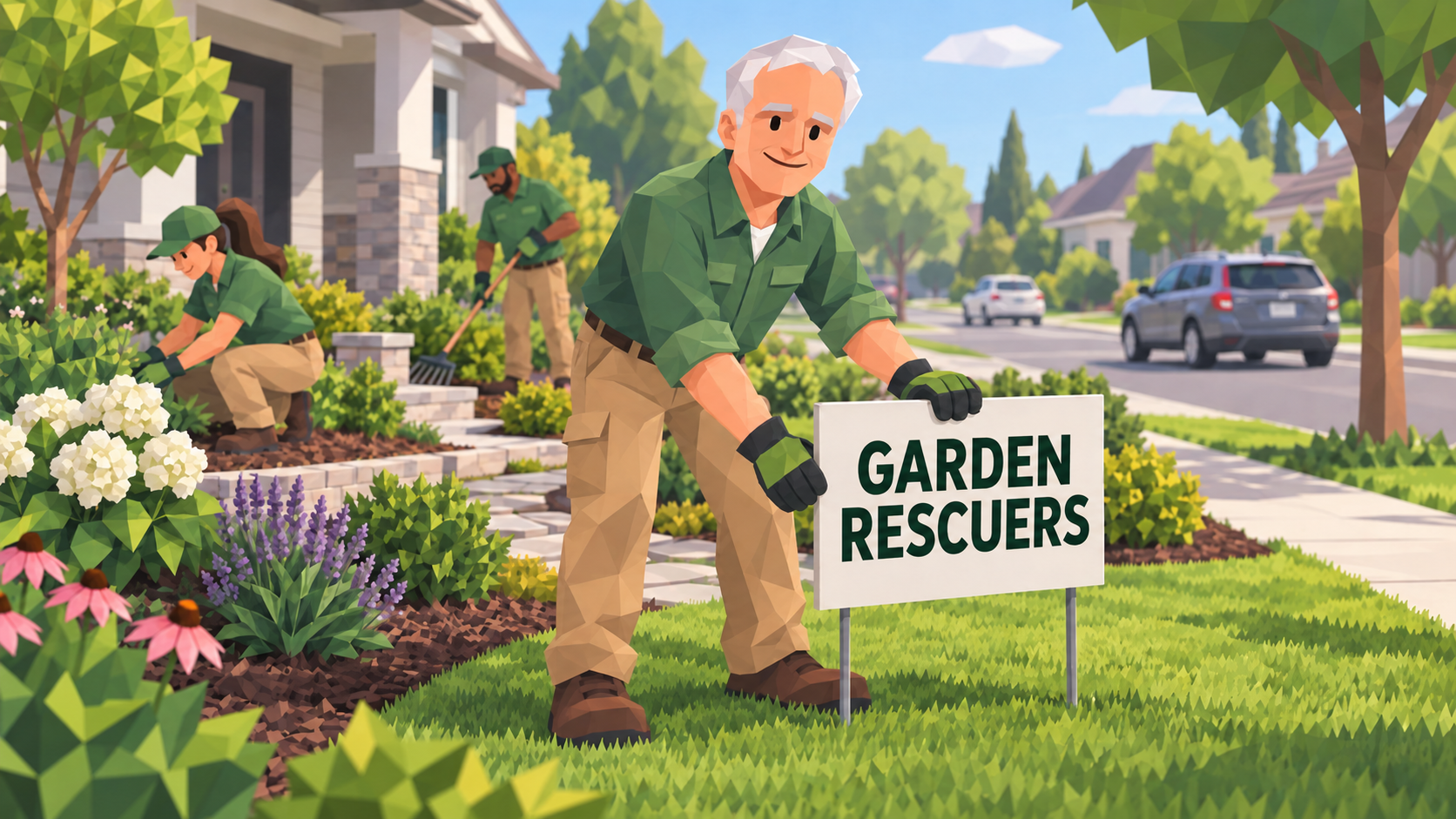
When we sign up a customer, we ask whether we can place a Garden Rescuers sign in their yard while we're doing the work. Most people have no problem with that. Occasionally, a really happy customer will even let us leave it up for the entire season, particularly if they're on a busy road.
But here's something interesting we've noticed. Most of our jobs might last two or three days, so that's how long the sign stays up. People driving around town start recognizing that pattern. They realize that if they want our phone number, they need to get it before the sign disappears.
So they take a picture of it with their phone.

We've had people call us and say they saw one of our signs three years ago. They literally saved the photograph on their phone for three years before deciding they needed gardening work done.
It's funny how the psychology works. A sign that was only sitting in someone's yard for a few days can still generate a customer years later.
The important thing I've learned from all this is that you shouldn't assume you know which marketing method will work for your business. I've tried other approaches, but these two methods consistently work for us.
If you're starting a plumbing business, lawn care business, pressure washing business or another home service business, your best marketing channel might be completely different. It depends on your customers, your service, your location and the circumstances of your particular business.
How do you get repeat customers and increase the value of each job?
We have every type of customer imaginable. Some people hire us once, and that's it. Some want us back every year, while others want regular maintenance throughout the gardening season. We also have customers who want us to come once at the beginning of the season and once at the end.
We don't really think about it in terms of upselling. What we think about is getting in there and doing some of the gardening.
Let's say we visit a customer who has a large property with several gardens that all need rescuing. If we prepare an estimate to do the entire property at once, the bill can get pretty hefty. Even somebody with plenty of money might hesitate when they see that number.
So we'll suggest starting with just one garden, perhaps the garden directly outside their front door.
We'll prepare an estimate for that one area, complete the work and let them see what we can do. Very often, they're so happy with the result that they ask us to come back and do the rest of the property.
We've gotten more additional work from that approach than anything else. In fact, calling it an upsell almost feels wrong because we aren't really selling them anything extra. They're the ones calling us and asking for more work after seeing the results.
How do you hire and manage your employees?
The first thing you have to understand is that this is a seasonal business. We're operating for roughly six months out of the year, so I can't promise somebody a full year of consistent work.
That affects the kind of people we hire. We've found that people who are later in their careers and looking to scale back can be a good fit. They might have spent 30 years working a regular job, enjoy gardening and now want something that gives them more flexibility.
Younger workers can be good too, although the challenge is making sure they have enough gardening experience. We need people who already understand the work.
I also deliberately pay more than landscaping companies typically offer. I'm not a gardener myself, so I need experts. Paying experienced people properly makes my life much easier because I end up dealing with fewer problems.
I'm looking for people who have years of experience, work well with others and don't have big egos. I don't want somebody who says they'll do one part of the job but refuses to spread mulch or do something else that's necessary.
I want people who genuinely love gardening and want to do an excellent job for our customers.

As far as finding employees, Indeed has been our main source. I'd estimate that approximately 80% to 90% of our hiring comes through Indeed. Occasionally, one of our gardeners recommends a friend, and we've hired a couple of people that way over the years.
Having the right people is incredibly important to how I run the business. When you hire experienced gardeners who can handle the work themselves, you don't need to spend your entire day supervising every little thing.
What would you do if you had to start over with only $1,000?
I think there's a question people rarely ask themselves when they're thinking about starting a business.
Do I love this?
Everybody wants to know how much money they can make, how quickly they can make it and what kind of workload they're going to have. Those are reasonable questions, but I think people often overlook whether they actually have a passion for the thing they're planning to do.
There are plenty of people out there who will tell you that it doesn't matter whether you love the business. You just have to put your nose to the grindstone and make it work.
I don't agree with that approach.
Gardening is physically demanding, and running a business comes with plenty of challenges. If you don't have some genuine interest in what you're building, I think you're making things unnecessarily difficult for yourself.
Before worrying about exactly how to spend that $1,000, I'd want to make sure this was something I actually wanted to pursue.
What advice would you give someone who wants to start a gardening business?
My biggest piece of advice is to take the first step.
Knock on a door. Make a yard sign. See if it works. Just do something.
You can spend months sitting around thinking about a business idea and trying to predict exactly what's going to happen. You can convince yourself that you've figured everything out before you've even started.
But the reality is that you don't know how customers will respond until you actually try something.
Maybe you knock on somebody's door and they aren't interested. Maybe your first yard sign doesn't generate any calls. That's fine. You've learned something, and now you can try something different.
If you take a step and discover you're heading in completely the wrong direction, at least you've got some feedback telling you that you need to change course.
You can't get that kind of information by sitting around speculating.
You have to actually do something.
So if you're considering starting a gardening business or any other small service business, don't wait until you've planned every last detail.
Take that first step and see what happens.
Where can we learn more?
Garden Rescuers: https://gardenrescuers.com/
Boring Business Blueprints: https://boringbusinessblueprints.com/